
Training the Messy Middle: What Functional Training Reveals About Skills Under Pressure
Functional Tactics Training is what most physical-skills training should be but rarely is. It is the question of how to train a learner for the messy middle of a confrontation, not the clean start or the polished end.
Training physical skills is easy to get wrong.
Not because trainers lack effort. Most trainers in this field care deeply, practise hard, and want their learners to go home safer. The problem is more awkward than that: much of what passes for physical skills training starts in the wrong place.
It starts from the clean bit.
The attacker throws the one punch we expected. The learner’s hands are up. The wrist appears where the wrist should appear. The knife arm freezes at the end of the attack. The handcuffing position is already almost solved. The “technique” works because the problem has been quietly edited into something teachable.
Live conflict does not behave like that.
Across three days of Functional Edge System CPD in Penrith, a mixed group of experienced trainers — from policing, healthcare, care, security, schools, lone working and self-protection backgrounds — explored a different question:
What if we trained the messy middle instead?
Not the perfect start position. Not the polished end position. The middle.
The bit where the learner is off balance. The bit where the first attempt fails. The bit where the person pulls away, drives in, stiffens, bends the arm, reaches for kit, produces a weapon, or simply does not behave like the diagram.
That is where this CPD became interesting.
A map, not a catalogue: how functional tactics training is structured
The course opened with a clear statement of intent: FES is not designed as a bag of disconnected tricks. It uses the Nine Attitudes model as a map running through self-protection, control tactics and weapon protection.

That distinction matters.
If a trainer teaches “a bit of boxing, a bit of wrestling, a bit of BJJ, a bit of police tactics” and then hopes the learner can assemble it under pressure, the learner is carrying too much cognitive load. That might work for a committed martial artist training several times a week. It is much less convincing for a frontline member of staff who has six hours, one day, or an annual refresher.
FES asks a more practical question: what can this learner realistically do with the time, body, confidence and role they actually have?
The model used through the week gave participants a way to locate themselves inside a confrontation:
- alert to what is happening
- prevent where possible
- survive when overwhelmed
- reverse enough to regain initiative
- engage where needed
- then resolve through escape, control or, in the most serious cases, a higher level of force
That might sound abstract until it is trained physically.

On Day 1, the focus was self-protection: flinch/startle responses, frames, movement, pressure, and the difference between surviving an assault and neatly performing a defence. On Day 2, the same principles moved into control: overhooks, underhooks, two-on-one positions, push-pull energy, resisting bodies, and the reality that control often begins in disorder. On Day 3, the same map was applied to edged weapon assaults: avoidance, deflection, arm control, chaos, fatigue, and decision-making when fine motor answers are unlikely to survive contact with fear.
That continuity was one of the strongest learning signals in the feedback.
Participants did not describe three separate courses. They described one thread.
One learner called it a “multi-tool with a volume dial on it”: the same simple tools used in different applications, scaled up or down depending on risk, context and learner capability.
That is a useful phrase because it captures the point. The value was not in giving trainers more techniques to remember. The value was in giving them a system for designing better practice.
The problem with teaching the end point
Several participants from policing backgrounds recognised a familiar problem in their own training systems: officers are often shown where they are supposed to finish, but not given enough time in the unstable route that gets them there.
Handcuffing is a good example.
In a classroom, it is tempting to move quickly from contact to cuffing. The officer reaches for the wrist, gets the hand, applies the cuff, and the scenario moves on. But the instructor delivery repeatedly challenged that sequence. If the person is not controlled yet, why is one hand already occupied with cuffs? If the officer is chasing the wrist, what happens when the person bends the arm, stiffens, turns, strikes, or drives through?
One instructor phrase from Day 2 captured this well:
Chaos, then control, then cuff. In that order.
That sentence should make trainers pause.
A learner who believes “I need to get the cuff on” may reach for the wrong thing at the wrong time. A learner who understands “I need to survive, reverse, control the person’s structure, then cuff when it is safer to do so” has a better decision sequence.
The feedback suggests that this landed.
Participants spoke about the value of spending time on overhooks, underhooks, upper-arm control, two-on-one positions and the “golden thread” of controlling the upper arm rather than chasing the wrist. They noticed how resistance creates information. If the arm bends, that is not a failure; it is a cue. If the person pulls away, drives in, or turns, the trainer can use that energy to teach the next problem.
This is where the course moved beyond “physical technique” and into training design.
💡 Key idea: A technique-led session often treats deviation as error. FES treated deviation as curriculum.

Layering pressure without throwing learners in at the deep end
“Layering” was the dominant word in the learner reflections.
Participants kept returning to the same idea: start thin, build gradually, then return to the scenario with more realism.
That is not soft training. It is how you build competence without drowning people.
On Day 3, during the edged weapon work, the instructors deliberately separated behaviours that would happen together in reality. First, learners worked on avoidance: can the body move off the line of the attack? Then deflection: can the arms instinctively protect without pretending to perform a neat parry? Then these pieces were recombined into more physical, chaotic drills.
One participant asked why the movement was being sliced so thin. The answer was instructional rather than tactical: because learners need attention on one thing long enough to build confidence and competence before the next layer is added.
That is exactly the difference between exposure and development.
- Exposure says: “Here is the full-speed problem. Cope with it.”
- Development says: “Here is the first useful behaviour. Practise it. Now add pressure. Now add movement. Now add resistance. Now add decision-making. Now keep going when the first answer fails.”
The reflections show that trainers recognised this. One participant described how the same scenario had effectively been trained for hours, but divided into different practice activities that could be tested, paused, explored and recombined. Another said it was remarkable how simple exercises could become physical and dynamic quickly, while still feeling controlled.
That matters for safety.
Good physical training is not measured by how chaotic it looks in the first five minutes. It is measured by whether the learner can enter chaos with enough preparation to learn from it.
Realism in functional tactics training is not just intensity
There is a lazy version of realism in physical skills training: make everything faster, harder and more aggressive.
That was not the realism that stood out in the FES CPD.
The realism participants valued was more specific:
- starting from disadvantage rather than a perfect stance
- dealing with failed attempts rather than stopping the drill
- allowing the attacker to lead movement
- letting the learner feel push, pull, stiffness and collapse
- training when tired enough for decision-making to feel different
- recognising that weapons may appear late, close and under stress
- accepting that fine motor answers may not be available
Several police trainers contrasted this with current edge weapon training. In some systems, the learner begins with the grab already in place. The two-handed grip is there. The knife arm is available. The rest of the drill becomes a route to the desired finish.
The FES approach challenged that. Before grabbing the weapon arm, the learner may need to avoid, deflect, move, recover, frame, crash in, or simply not get cut again. One participant put it bluntly: they needed to “rewind it” and teach avoidance before grabbing.
⚠️ Warning: If a learner leaves training believing the answer to a knife is “grab the arm”, we may have created false confidence. If they leave understanding that grabbing may be one option after survival behaviours have bought the opportunity, that is closer to reality.
Day 3 made this especially clear. Participants described the weapon work as stressful even with a blunt training knife because the stimulus changed the body’s response. A punch drill may feel like training. A blade-shaped object, even rubber, changes attention. It makes people flinch. It makes them rush. It makes them discover whether their preferred answer still works when the problem feels nastier.
That does not mean trainers should sensationalise weapon training. Quite the opposite. The delivery kept returning to proportion, safety, context and the limits of what can be achieved in a day.
But it did mean the training had enough emotional truth to expose weak assumptions.
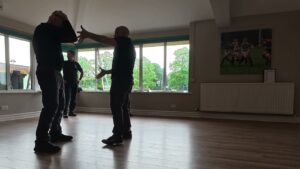
The trainer lens matters
This was not an end-user course. It was instructor CPD.
That distinction shaped the week.
Participants repeatedly noticed the separation between what the learner needs to experience and what the trainer needs to understand. That is a mature design choice. End users may need a small number of usable behaviours, repeated under pressure. Trainers need the map behind those behaviours: why the drill exists, what to watch for, how to scale it, when to pause, when to let failure continue, and how to connect a messy rep back to a principle.
One learner said that other courses often mix the two: either giving trainer-level theory to people who need practice, or giving instructor candidates a learner experience and then saying “go teach it” without enough background.
The FES CPD seemed to work best when it held both levels in view.
Participants were not just practising frames, controls and weapon responses. They were also asking:
- How would I break this out for my learners?
- How much of this fits my sector?
- Which layers would I use with a new learner?
- Which layers would I skip or accelerate with experienced staff?
- How do I make this safe in the venue I actually have?
- How do I connect this to my legal, policy and operational framework?
- How do I keep my own end-user skill alive while also coaching others?
That last point is easily missed.
Trainers need two kinds of repetitions. They need coaching reps — observing, cueing, scaling, debriefing. But they also need end-user reps — feeling the pressure, making decisions, failing, recovering, adapting.
Several participants were honest about this. They worried about skill fade. They asked for solo drills, heavy bag ideas, resistance-band work, refresher days, drill lists and digital notes. That is not a weakness in the course. It is a sign that the course created enough physical and cognitive demand for trainers to recognise that one exposure is not enough.
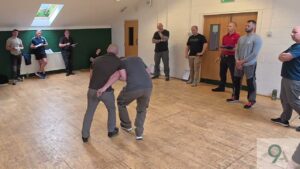
What the learner feedback actually shows
📊 Impact snapshot: The impact report scored the immediate evidence at 58 out of 100, with a confidence score of 80. Strong relevance and intended behaviour change; workplace impact not yet measured.
The feedback shows strong evidence of relevance, learning and intended behaviour change. Participants could name what they learned and where they would use it. They were not giving vague praise. They talked about specific applications: police SBT, handcuffing, baton, PAVA, taser limitations, dementia care, mental health settings, secure youth services, lone working, security training, and future Dynamis delivery.
They also raised specific criticisms and implementation issues:
- warm-ups mattered, especially before grappling-heavy days
- police trainers wanted clearer links to SBT, NDM, PPE and verbal commands
- some teaching blocks could be shorter and more bite-sized
- trainers needed drill maps to organise the volume of material
- future transfer would depend on time, permission, facilities and follow-up practice
That kind of feedback is more useful than applause.
It tells us the course was not simply enjoyed. It was interrogated by experienced people thinking about implementation.
The impact report was also careful not to over-claim. The reflections were captured immediately after training, often in pairs, with the normal risks of recency, fatigue and social desirability. The strongest evidence is not yet workplace impact. It is anticipated transfer.
A participant saying “I will use this tomorrow” is valuable, but it is not the same as observing them deliver it well six weeks later. The strongest evidence is not yet workplace impact — it is anticipated transfer.
Still, immediate transfer intent is not trivial. Especially when it is this specific.
One participant had a course the next day and could already see how to build the edged weapon layers into it. Police trainers identified where survival and avoidance needed to sit before control and cuffing. Care-sector trainers saw relevance for dementia, mental health and learning disability settings. Secure youth trainers connected the work to improvised weapons and the need to spot the weapon before it became a close-quarter fight.
That is a credible pathway to impact.
Why “mistakes” may be the best part of functional tactics training
One of the strongest themes from Day 3 was the value of getting it wrong.
Not in a careless way. Not by creating unsafe practice. But by giving experienced adults room to discover what fails.
A participant described trying something during a weapon drill, taking an arm off at the wrong moment, and being repeatedly “stabbed” with the training knife. The first reaction was embarrassment: I’ve done it wrong. The better reaction came a second later: that mistake taught me something I will not forget.
That is good training.
If every rep is engineered so the learner succeeds, the learner may leave with a false model of their own capability. If every rep is a chaotic punishment, the learner may leave overwhelmed. The sweet spot is structured difficulty: enough failure to create learning, enough support to keep the learner engaged.
Several participants connected this to adult learning. Rather than correcting every deviation immediately, trainers can let learners explore grip, pressure, movement, body type and decision-making. The role of the instructor becomes less about forcing a perfect shape and more about guiding the learner towards workable principles.
That fits the reality of conflict.
Two people can face the same problem and choose different reasonable actions. Different bodies, roles, policies, environments and options will lead to different solutions. The standard is not “did it look exactly like the diagram?” The better standard is: did the learner make a reasonable, proportionate, tactically sound decision that improved safety?
That is a harder thing to teach. It is also the thing worth teaching.
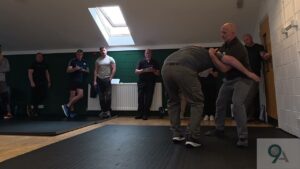
The implementation challenge for PPST and PMVA trainers
The course appears to have done its job as CPD: it changed how trainers were thinking.
Now comes the harder part.
For police trainers, the challenge is curriculum time. Some described having only 10–15 minutes for edged weapon breakouts inside a larger refresher. That makes a full FES-style progression difficult. The answer may not be to “fit the whole course in”. It may be to identify the most valuable layers and use them deliberately: avoidance before grab, survival before control, pressure before polish, PPE decisions after realistic contact.
For care, education and secure settings, the challenge is role fit. Staff may not be expected to close with a weapon threat. The more relevant learning may be early recognition, distance, containment, escape, communication, and last-resort survival if the threat is already on top of them. FES can still help, but only if adapted ethically to the role.
What this says about good functional tactics training
The most useful outcome from this FES CPD is not “these drills work”.
That would be too simple.
The better conclusion is that trainers need to design physical skills training around the real shape of conflict: uncertain starts, failed attempts, pressure, resistance, fatigue, fear, role limits, legal judgement and recovery.
Technique still matters. Of course it does. But technique without a pressure pathway becomes brittle. A learner may perform it in the room and lose it when the person in front of them behaves like a person rather than a training partner.
FES offered this group a way to build that pathway.
Start with instinctive behaviour. Give it a name. Give it a goal. Add a frame. Add movement. Add resistance. Let the attacker lead sometimes. Let the defender fail sometimes. Pause and extract the learning. Put it back into the scenario. Keep the same map running through self-protection, control and weapons so the learner is not constantly changing operating systems.
That is why the learner feedback was so consistent.
People valued the simplicity because it was not simplistic. They valued the layers because the layers helped them handle complexity. They valued the realism because it did not begin with theatre; it began with small behaviours that could survive pressure.
Bottom line?
If we want people to perform safely under stress, we have to stop training only the clean parts. We have to train the messy middle — carefully, progressively, ethically, and with enough repetition that learners can still think when the first answer fails.
That is where physical skills become more than techniques.
That is where training starts to look like work.
Sources and further reading
Authoritative references for PPST and PMVA functional tactics training:
- Home Office — Personal Safety Training (PST) Guidance v3.0 (UK government guidance for police personal safety training)
- Suffolk Police — Public and Personal Safety Training Policy (UK police force PPST policy)
- Surrey and Sussex Police — Public and Personal Safety Training and Equipment Policy