For response officers, neighbourhood teams, PCSOs and custody staff. Training that gives the first minute of a confrontation a shape, so force becomes a decision rather than a reflex.
Force must be lawful, necessary and proportionate, and no more than the situation requires.
Our training standard
Capability at the point of contact
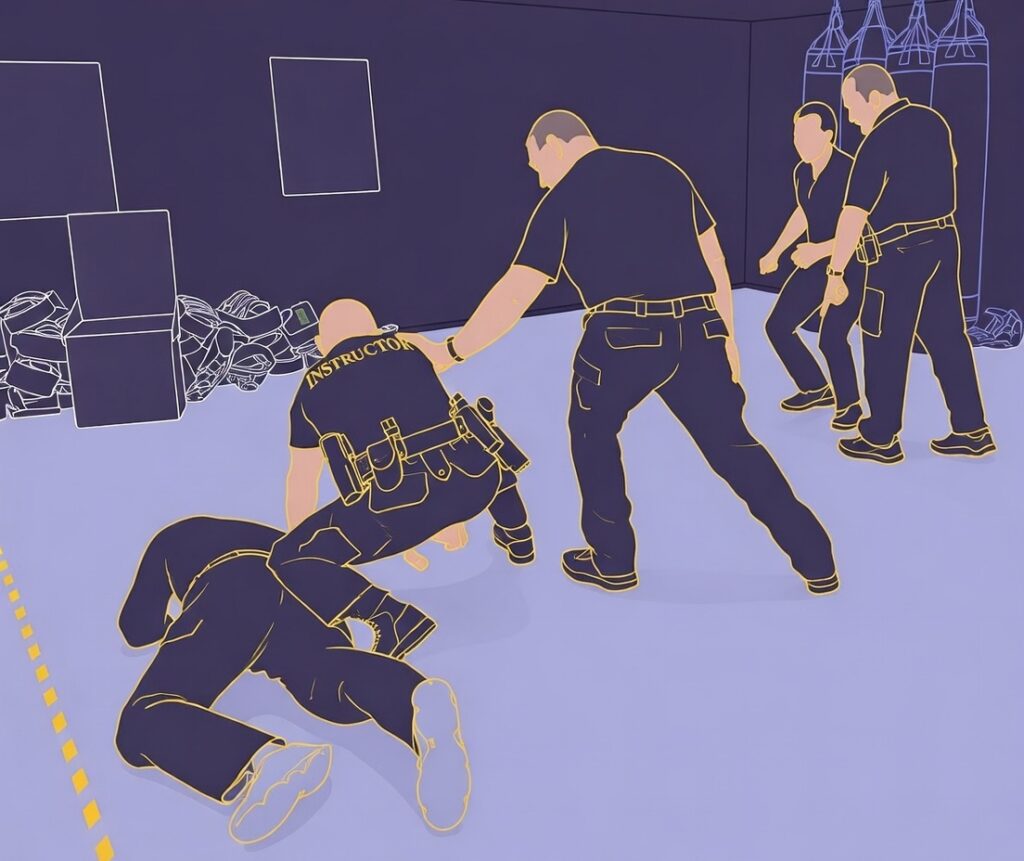
Officers leave able to slow a situation before it needs hands, move a colleague out of a corner, and write the decision up in words scrutiny will read. The scenarios come from calls that fill a Saturday night.
01
Use-of-force decision-making
02
Spoken de-escalation
03
Positioning and exit awareness
04
Team coordination at a scene
05
Custody suite communication
06
Recording and justification
07
Debrief after an incident
08
Recognising acute distress
What forces ask of a provider
A standard every officer can name
Defensible use-of-force decisions
Fit around abstractions and nights
Scrutiny-ready accounts of a decision
Post-incident welfare taken seriously
Built from the calls officers describe, then rehearsed until the words arrive without being searched for.
SDT (Scenario-Driven Training)
From the briefing room to the cell
We start with what your officers meet on a Friday night and what the record says afterwards. Two forces will describe that differently, so the programme starts differently too.
01
We read what the force already holds: use-of-force entries, complaints, calls escalated twice. Then we watch a handover and ask sergeants where it goes wrong.
Diagnose
Diagnose
We read what the force already holds: use-of-force entries, complaints, calls escalated twice. Then we watch a handover and ask sergeants where it goes wrong.
02
Scenarios from calls your officers know, run in the rooms where they happen: a cell, a charge desk, a stairwell at closing time. Then a harder version of the same call.
Training
Training
Scenarios from calls your officers know, run in the rooms where they happen: a cell, a charge desk, a stairwell at closing time. Then a harder version of the same call.
03
Sergeants carry it after we leave. Short briefings before a shift, one shared way of describing the first minute, refreshers that fit around abstractions.
Embedding
Embedding
Sergeants carry it after we leave. Short briefings before a shift, one shared way of describing the first minute, refreshers that fit around abstractions.
04
We compare what changed in the record and in the room: how decisions are written up, what supervisors now spot, and where practice still splits between teams.
Evaluate
Evaluate
We compare what changed in the record and in the room: how decisions are written up, what supervisors now spot, and where practice still splits between teams.
A conversation about the decisions your officers face
Dynamis reworked the 9 Attitudes instructor course and runs it at Loughborough from 24 to 26 November 2026. Three days cover attitudes, high-risk control tactics and edged weapon protection, with places limited to 14....