
This post is about conflict management, personal safety, and Dynamis training. A Breakaway training day from Dynamis is designed to enable public-facing staff who face the imminent threat of violence or a violent assault, giving them the appropriate attitudes and tactics for personal safety.
If danger cannot be avoided any other way, staff should break away or disengage from violence and move towards safety using appropriate personal safety or self-defence skills.
But look at the schedule: some providers only allocate 90 minutes of practice time in a whole day of breakaway training.
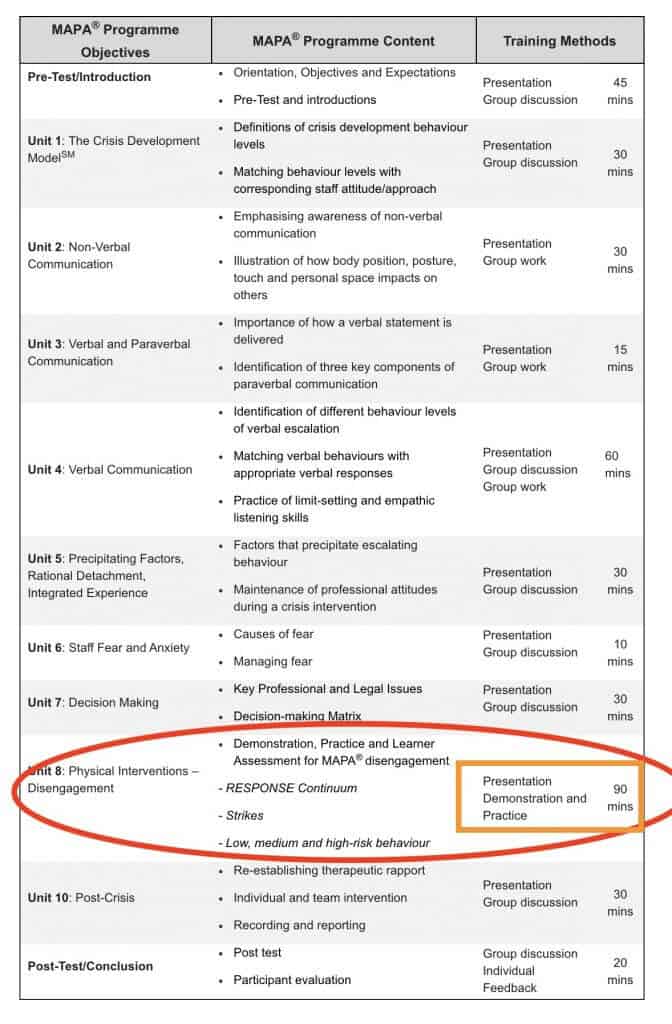
In an evidence-based world, how can this be?
Research after research, some conducted well over a decade ago, tells us that breakaway training requires a fresh approach. Time on task is a critical component of successfully transferring skills to the carers, nurses, doctors, and other professionals we teach.
In 2019, in a world increasingly focused on evidence-based practice, how can we still run programmes that give staff physical skills while allocating so little time to actually practising them?
💡 Key takeaway: If people are on a training course to learn to do something, it makes sense they spend most of the day doing it — not listening to someone talk about it.
Here is a video about how important time is in training in general, not just on a Breakaway Training Day:
“Time on task is a proxy for learning”
I once asked Professor Chris Cushion about one of the most powerful analyses he does during coach development — a time-on-task analysis. He told me that every coach trying to ensure learning in their class needs one piece of kit.
“The number one piece of kit, and it’s really inexpensive, would be a stopwatch. Because time on task is a proxy for learning, and you need to be in control of time for a whole range of reasons — to maximise time on task, to limit the war stories, to manage transitions and breaks. Time slips away.”
— Prof. Chris Cushion
Meshing verbal and physical skills
Why are verbal skills given no practice time?
When we looked at this, we wondered: how come the verbal skills were separated from the physical skills and given no practice time on the Breakaway Training Day?
Here is a video about how important “meshing” is in training:
Meshing the verbal skills with your breakaway techniques
Let me ask veteran trainer Gary Klugiewicz from Vistelar to give you his view.
“A lot of people say ‘talk nice to people who aren’t talking nice to you.’ That works until the first person gets in your face and starts calling you names. Then you get angry and upset. What we have to do is not do fire talks — lectures about talking nicely — but fire drills, where we actually practise, set up scenarios, and train scripts.”
— Gary Klugiewicz, Vistelar
Why practice should be the focus of your training
Here are five reasons practice should sit at the centre of training in all domains — not just on a Breakaway Training Day.
📊 Why practice matters: Practice increases retention, builds automaticity, improves transfer to new problems, helps learners acquire expertise, and drives motivation for more learning.
- Practice greatly increases the likelihood that students will permanently remember new information (Anderson, 2008).
- Practice increases student facility or automaticity — learning to apply elements of knowledge automatically, without reflection. Automaticity frees up cognitive resources to handle more challenging tasks (Brown & Bennett, 2002; Moors & De Houwer, 2006).
- When students practise solving problems, they increase their ability to transfer practised skills to new and more complex problems — in childhood (Glover, Ronning, & Bruning, 1990) and in adult years (Li, Schmiedek, Huxhold, Röcke, Smith, & Lindenberger, 2008).
- Practice helps students acquire expertise in a subject and distinguishes novices from experts (Ericsson, Krampe, & Clemens, 1993).
- Cognitive gains from practice often bring about motivation for more learning (Kalchman, Moss, & Case, 2001).
Next steps
To learn more about maximising training effectiveness — as a CPD activity for trainers who teach conflict management, physical interventions, officer safety, or PMVA — visit www.dynamis.training/scena.
To learn about our Breakaway Training, go to www.dynamis.training/breakaway.
This guide on conflict management, personal safety, and Dynamis training is part of our ongoing work with schools and academies.