
This post is about conflict management | personal safety | dynamis training. Lone worker safety devices have proliferated in the past decade, but are they really useful in the most crucial of moments? The question isn’t whether the technology works — it’s whether a human being under extreme stress can actually operate it.
Our human survival system is extraordinary. It works faster than the ‘plodding of logic’ and can flood our body in an instant with a hormonal cocktail that enables Olympian feats of strength, speed, and endurance. Your deeply embedded DNA-level survival system will always try to protect you in the face of sudden, aggressive threats in close proximity to your body.
The effects of arousal on behaviour, beginning with the Yerkes-Dodson analysis, help us to understand what happens in high-intensity, high-stress moments.
When faced with an imminent threat, as a species of highly successful survivalists, we are wired-up to experience:
None of which are well-suited to tasks such as:
“An officer had to apply CPR on his infant daughter. He handed the phone to his wife and told her to dial 911, but she couldn’t do it. She could not see the numbers and she could not use her fingers, even to save her own child’s life.”
Lt. Col. Dave Grossman
⚠️ The hard truth: If a mother cannot dial 911 to save her own child, what chance does a lone worker have of operating a complex safety device while facing an aggressor?
In another story, when a woman found someone kicking down her kitchen door:
“She fumbled desperately with the telephone but she could not see the numbers. She did manage to press the zero button, which ultimately saved their lives.”
Lt. Col. Dave Grossman has stated that “the more stressed you become, the more narrow the tunnel. There will also be a loss of depth perception and a loss of near vision, meaning that you have trouble seeing close things. It is a terrible irony that at a time when you need your eyes the most, you may lose your near vision.”
At one of our training sessions, a team had been provided with a system based on mobile phones to make a “Condition Red” call to a dedicated lone worker safety service. The system required the person to push and hold the number “5” button on their mobile phone — now updated to the power button SOS call with a slightly better prognosis — which would put them through to an operator who would immediately begin recording and monitoring the worker’s situation.
However, this particular system had serious shortcomings. First, the team had been informed by email that they were responsible for setting up their own phones to call out on the number “5” speed-dial. Quite predictably, the staff team were not 100% compliant. That’s the first point at which this expensive lone worker safety device system was starting to fall over.
The number “5” was chosen because every number “5” on every mobile phone keypad has a raised dot that identifies it. Sure enough, we find this to be true — though the prominence and positioning of the 5-dot varies widely. In some cases it is off-centre, perhaps closer to the top of the button. When we say the top button, we mean when the phone is in an upright position — not upside-down inside a pocket or handbag. And perhaps this all assumes you are not using a smartphone whose keypad is a flat touchscreen with a keypad lock on it.
Details, details. They matter when you need to call for help as a lone worker.
What would we observe staff doing in a moment when they are exposed to highly aroused, aggressive individuals threatening physical violence — to the point where they are experiencing the physiological effects mentioned above?
We want them to find and press the number 5 button — and only that button, since speed-dialling any other number will be ineffective. The worker who is calling for help may or may not be looking directly at the number. They must achieve the task with fingers that are numb, shaking, and de-sensitised by the action of cortisol and adrenaline in their bloodstream, causing vaso-constriction and robbing them of fine motor control.
All the while, our role-player assailant will be applying heat to the system — aggressive, posturing, and threatening, continually firing up the worker’s innate survival system hidden deep within their brain in the tiny, primitive amygdala fear-centre.
The result is fairly predictable: system failure in most scenarios, dependent largely on the awareness, preparedness, and mindset of the workers we might test in this hypothetical experiment.
💡 Stress inoculation: The more experienced someone is in facing a particular type of stressor — such as aggression — the less impact their primal survival responses will have on their behaviour. Training can provide this inoculation. But the emphasis must be on training the person, not just training the kit.
In one video we show to our training groups, a policeman whose colleagues are being beaten severely by an offender decides to throw down his baton and instead use CS spray. He drops his baton and takes one, two, three, four, five, six seconds to find, unclip, draw, prepare, and deploy the spray — all while his colleague is being punched and bounced off the furniture and walls of the room.
Our purpose in pointing out these deficiencies is not to decry the use of devices completely. It is to remind the social and health care sector that, in the face of real aggression and violence, the person who ultimately holds the final power to influence the outcome is the worker themselves.
By their behaviour, their body language, their positioning, their listening and questioning skills, their tactical awareness, and their emotional commitment to safety — the worker alone will exert the largest influence on what happens in the client’s front room, hallway, bathroom, or bedroom.
Nevertheless, managers have a responsibility to supervise their lone workers so as to control the risks prevalent in their workplace. Safety devices do a tremendously helpful job of enabling this in a relatively efficient and cost-effective way, answering questions such as:
We are positively in favour of lone worker technology when it meets these criteria:
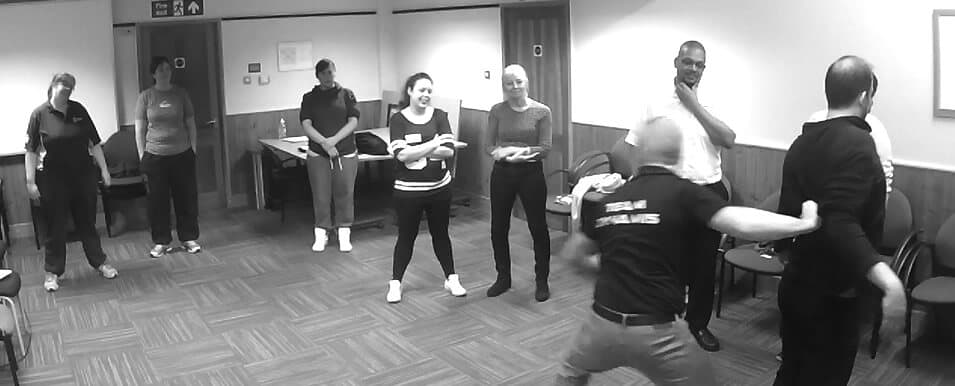
Gerard O’Dea provides Lone Worker training, personal safety, and conflict communications courses for organisations across the spectrum of public services. Parking Wardens, Home Care Workers, Car Leasing Debt Recovery teams, and Housing or Social Workers all over the UK have learned how to stay safer in his Lone Worker Personal Safety training courses since 2006.
No lone worker safety devices were harmed in the production of this blog post.
For more information about our Lone Worker training, click here.
This guide on conflict management | personal safety | dynamis training is part of our ongoing work with schools and academies.