
Spotting the signs of escalation during lone working conflict
This post is about conflict management | personal safety | dynamis training. Inter-personal conflict induces a release of adrenaline in the body, causing a number of changes in a person’s physiology. Some of these changes have outward, observable results that can serve as early warning signals — if you know what to look for.
- Facial colour change
- Change in breathing
- Movements become larger and ‘jerky’
- Pacing and repetitive movements
- Suddenly speechless or monosyllabic
- Staring or ‘looking through you’
- Aggressive gestures
1. Facial colour change
Drastic changes in heart-rate and blood pressure cause a change in blood-flow to the extremities. For anger, we usually register the red face; for fear, we register the whitening of the face.
Either condition warns you of a deep and significant adrenaline rush that is making the person more dangerous and less rational. This is a good time to take a step back and introduce a barrier signal.
You will observe: reddening or whitening of the face.
2. Change in breathing
To feed the engine of survival athleticism, the body initiates vaso-constriction — squeezing the blood vessels of the extremities tight and forcing blood volume to concentrate in the torso.
The engine driving athletic performance receives large volumes of oxygenated blood, while the body increases the rate at which it sucks air in and pushes it out. In simple language: more coal in the furnace.
You will observe: deepening (heaving) or quickening of the breathing; a deep inhalation or exhalation.
3. Movements become larger and ‘jerky’
Our survival system is wired for sprinting, climbing, and jumping out of danger. It has not yet wired itself to maintain dignity or project calm when escaping serious threats.
The evolutionary imperative is simple: use the big push/pull muscles of the chest and the powerful thrusting muscles of the legs to get away from danger. The larger muscles — which contribute most to gross motor movement — are engaged, while the smaller muscles for fine or complex motor movement are disengaged.
The result is the expressive, demonstrative behaviour that Rory Miller has called the ‘Monkey Dance’ in his books, such as Meditations on Violence.
You will observe: expressive, wide, large-format movement with powerful, tense qualities.
4. Pacing or repetitive movements
In an effort to work off the excess energy now coursing through the system, the person — quite possibly without conscious awareness — initiates a repetitive movement cycle. The most common is pacing: walking up and down to dissipate the tremendous energy building up in their legs.
Their legs want to carry them far away from this stressful situation, or power them to climb a tree, or kick something really hard.
Sometimes the pattern isn’t pacing but a different repetitive action — stroking an arm, nodding, shaking the head. It may be a self-comfort signal. Something about our crisis survival behaviour favours repetition. Notice this pattern and acknowledge it.
You will observe: a repetitive pattern, most often pacing, but also possibly any other repeated action.
“I was talking to the service user about this difficult decision we were trying to make together and then, after I raised a particularly contentious point, they suddenly went really quiet and turned away. Next thing I knew I was seeing stars — he punched me in the head!”
5. Suddenly speechless or monosyllabic
The same vaso-constriction affecting the fingers also affects the lips and tongue — the tools of speech. Under a strong adrenaline-dump survival stress response, the person’s ability to put thoughts into words dims, and their motor skills for forming speech deteriorate.
A person who is going to hurt you usually has to go through a process of dehumanising you first. The look-away and the silence may be part of this.
You will observe: a quietening, a narrowing of focus — but away from you. They were talking, and now they’ve gone quiet. Be cautious.
6. Staring — ‘looking through you’
During a survival moment, your primal systems won’t want to miss a moment of what’s happening. The blink reflex shuts off, pupils widen, and the brain’s visual data-processing speed increases dramatically — you can literally see things that otherwise aren’t there.
This effect can also happen when someone sees you as the threat: they fixate, pupils widen, appearing to look right through you. Some research into the personal safety practices of night workers found their number one safety rule was to watch for the ‘thousand yard stare’.
You will observe: a fixed gaze, looking through you or seeming to look in your direction but not at your eyes. The person engages you with their eyes but not conversationally.
7. Aggressive gestures
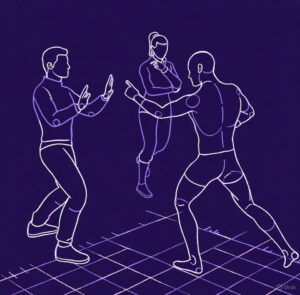
Desmond Morris, the well-known author and body language expert, described the ‘finger baton’ and its origins. In situations where there is a difference of opinion, one person may employ this gesture to emphasise their point of view. It is a reasonably reliable indicator of how aroused the person is — a primal, deep-level behaviour.
You will observe: a wagging or pointing finger, brandished in front of your face and directed towards you. It may manifest as a fist, or the hand may hold an object as an improvised weapon.
[!] Warning: Any of these seven signs — alone or in combination — signals a significant adrenaline response. When you spot them, create distance, use barrier signals, and avoid escalating the situation further. The person’s rational brain is being overridden by their survival system.
Conflict Management | Personal Safety | Dynamis Training: What comes next
Once you can recognise these signs of escalation, the next step is learning how to respond — broadcasting body language that enhances safety rather than fuels the conflict. Our lone worker training covers these practical techniques in depth.
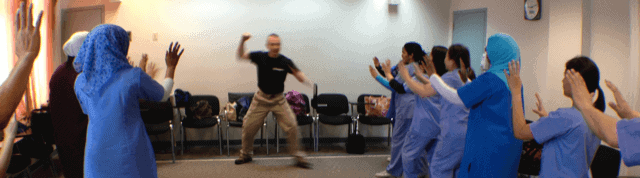
Gerard O’Dea is a professional violence-management trainer and consultant who has been active in personal safety training since 2006. He regularly delivers training to local authority, housing organisation, and other community-based staff teams who work with sometimes difficult, distressed, or dangerous members of the public. His approach to lone-worker training is pragmatic, functional, and based on a keen analysis of real-world community working.
Gerard published Lone Worker Personal Safety: A Guidebook for Health and Social Care Staff (on Amazon in Paperback and on Kindle) in 2014. For more information, visit dynamis.training/lone-worker-personal-safety.
This guide on conflict management | personal safety | dynamis training is part of our ongoing work with schools and academies.