
Staying relaxed under pressure can sound like the opposite of tactical readiness. It is not.
In the FES 9 Attitudes framework, relaxation is the baseline. It is the state you want to live in most of the time because it gives you access to better perception, better movement, better judgement and better communication. That matters because conflict does not usually begin with a dramatic attack. It begins with a shift: a tone changes, a person closes distance, an atmosphere tightens, or something no longer feels normal.
A tense person often misses those early signs. Not because they do not care, but because their system is already overloaded. When the body is locked up, attention narrows. Breathing changes. The shoulders rise. The person starts burning energy before anything has happened. They may become more reactive, more easily provoked, and less able to distinguish between a real threat and a difficult moment.
Relaxation is different. It gives you room.
It allows you to listen without immediately defending yourself. It allows you to notice the whole picture rather than fixating on one angry face. It allows you to move without stiffness. It helps your voice stay steadier. It gives you a better chance of using judgement before instinct takes over.
This is not “soft skills” in the dismissive sense. It is a safety skill.
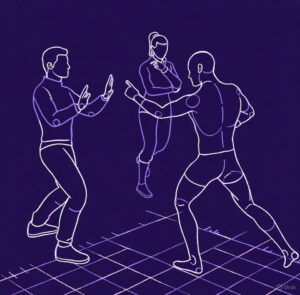
In public-facing work, the relaxed professional often has more influence than the tense professional. They can set a calmer emotional temperature. They can avoid turning a disagreement into a status battle. They can keep their hands available without looking aggressive. They can step back or angle away without looking as if they are retreating in panic.
And if things do get worse, relaxation still matters. A person who begins from a calmer baseline can often escalate their own readiness more intelligently — moving from relaxed, to alert, to preventive, rather than jumping straight from conversation to panic.
Nobody is relaxed all the time. Not in healthcare, education, security, social care, transport, retail, or any setting where people under pressure meet other people under pressure. But relaxation can be trained as a recoverable state.
Staying relaxed under pressure: building reset points into the working day
A simple practice is to build “reset points” into the working day: unclench the jaw; drop the shoulders; breathe out fully; soften the knees; scan the room without staring; ask, “What is actually happening — not what am I imagining?” That last question matters: relaxation helps separate signal from noise.
The goal is not to become passive. The goal is to stay available — available to think, available to move, available to speak well, available to act if needed.
Staying relaxed under pressure is not the absence of readiness. It is the foundation that makes readiness more useful.
Related reading and training
- Personal Safety
- Awareness vs Alertness: What ‘Just Be Aware’ Gets Wrong
- Conflict Resolution: Be Alert and Decisive