
Healthcare Myth 1: Killing them with Kindness
Here is Vistelar Consultant Joel Lashley talking about some myths in healthcare, and in particular the belief that we need to present kindness at all times — or minimise our recognition of intimidating or disrespectful behaviour in our healthcare facilities. Interested in Becoming a VDI Instructor? You will have your chance at the first-ever VDI […]
Reacting more quickly: Stimulus Identification in Breakaway Training
Stimulus Identification is a huge part of being able to respond to it One of the most important factors which influences Reaction Time (RT) and decision-making is the number of possible stimuli the performer must choose from at any given time – each of which may need a distinct response action to be programmed. […]
Understanding Reaction Time in Restraint Training and Personal Safety

In sports science, there is a vast and growing body of knowledge on the subject of Reaction Time, as it is one of the key components of the performance of skill. Reaction Time is defined as the interval of time that elapses from the sudden presentation of a stimulus to the beginning of a person’s […]
The Science of Defensive Postures for Training in Restraint and Personal Safety

Stimulus-Response (S-R) Compatibility is the scientific principle describing the “naturalness” of the connection between a stimulus and the associated response. Reaction time for a skill is faster when the stimulus-response pair feels instinctive — and slower when it doesn’t. Think about turning a car steering wheel left in response to an upcoming left turn. That […]
Using Desirable Difficulties in Restraint Training
As physical skills trainers, is there something we can learn from the educational researcher Robert Bjork? Much training in physical intervention skills focuses on a linear learning process — start with “the basics,” progress through “intermediate” skills, and reach full competency. But one researcher studying a Breakaway training package found something alarming: with a long […]
Retail Security Risks and Training in Personal Safety

I read with interest this appalling — but familiar — story about a female security guard being stabbed with a syringe in a Sainsbury’s in Kent. The security guard confronted a drug-taking subject as he attempted to steal a bottle of whiskey from the supermarket shelves and make off with it outside the store. The […]
What is great conflict management training?

Great conflict management training builds self-efficacy, and that is what changes how staff behave under pressure. Self-Efficacy: Conflict Management is about more than just ‘Techniques’ When people learn that they can master tasks, they start to develop a feeling of self-efficacy – the expectation that they will be competent and successful at a particular task. […]
Restraint Training: The Biggest Mistake in Control Tactics
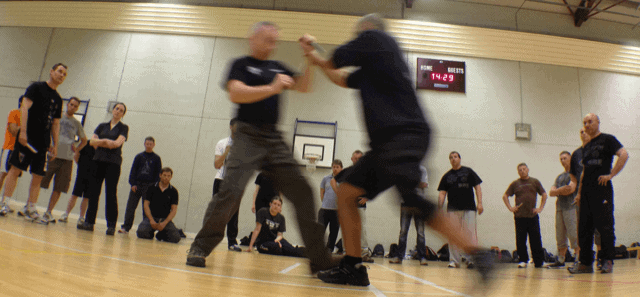
Coach Tony Torres says that the biggest problem in Control Tactics is that people try to exert control too soon in the confrontation timeline. The biggest problem in Control Tactics is that people try to exert control too soon in the confrontation timeline. The Three Phases of Any Confrontation In our 9 Attitudes methodology from […]
Hospital Violence Reduction – Organisational Commitment
Leadership Commitment to the Hospital Violence Reduction Project Sometimes in the hospitals we visit, nursing staff do not feel that they have the full support of the organisation in managing incidents of violence or aggression in their work — even though there is an active Hospital Violence Reduction Project in play. This is underlined by […]
Restraint Training Programmes and Accreditation
While reviewing documentation in regards to training needs analysis recently, I came across an interesting piece of research carried out by the Health and Safety Executive and published in 2006. In it, the researchers sought to evaluate training in violence management in the UK and find good practice advice. The document emphasises in a very […]