
This post is about conflict management | personal safety | dynamis training. The accompanying images in this post show something that has been referred to as a “Therapeutic Floor Hold” in some training materials. It constitutes, in our view, inappropriate restraint. The (usually) vulnerable person being restrained is first taken to the floor — often through some kind of unbalancing using a trip. Once on the floor, the staff fold the person’s arms around their body (forming a cradle or wrap position) and then hold them from behind to restrict their movement. The person on top simply applies their bodyweight to the subject underneath, immobilising them through greater mass and gravity.
The unfortunate thing about a technique like this is that it works, to a large extent. It may even work so well as to be inescapable.
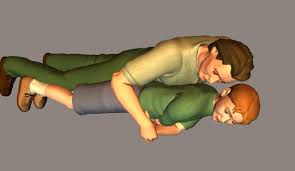
⚠️ Warning: This technique is an example of restraint that should not be used. Don’t do this.
In this series we have described holds where the person on the floor is being subjected to the force of a heavy mass on top of them, pushing down through their body. The compression can have — especially over a period of minutes — significant effects on the person’s physiology.
Their cardio-respiratory system becomes compromised. They go into cardio-respiratory distress and, unable to move to relieve the pressure, they eventually expire. Much has been written on this subject and research continues into the causes and effects of different staff actions and the subject conditions which exacerbate the issues.
Certainly, wherever possible, prolonged pressure on the back of a restrained subject must be avoided. Don’t lie on top of people when you restrain them.
📊 The evidence: Compression-induced cardio-respiratory distress is a well-documented cause of restraint-related deaths. Any technique that places bodyweight on a prone subject’s torso should be removed from your syllabus immediately.
Here is the real problem with this restraint technique. It is most often used in children‘s care environments — and it is therefore most often used with our most difficult, distressed, and defiant children.
Those children become defiant and difficult to work with because they often come from a context and environment where despicable things have been experienced by them. Sometimes the despicable thing has happened to them directly. And often, it was at the hands of an adult who overpowered them and then inappropriately touched or violated them.
Now look at the pictures again and feel the revolting surge of “DON’T DO THAT!” — which should be any right-thinking person’s response to such a technique.
For a child who has experienced trauma at the hands of an adult, being pinned to the floor by a larger, heavier person is not a therapeutic intervention. It is a re-enactment of abuse. The technique’s very effectiveness — its inescapability — makes it uniquely damaging for vulnerable children.
We need to design and implement restraint techniques for working with children which avoid becoming inappropriate restraint. Instead, the techniques should be:
💡 Key takeaway: Effective child restraint must meet three tests: it protects staff, it safeguards the child, and it doesn’t re-traumatise. The Therapeutic Floor Hold fails all three.
In our next post in this series we will look at more fragile restraint techniques and hope again that no-one is including them in training, anywhere.
All the best for now,
Gerard O’Dea, Director of Training, www.positivehandling.co.uk
This guide on conflict management | personal safety | dynamis training is part of our ongoing work with schools and academies.