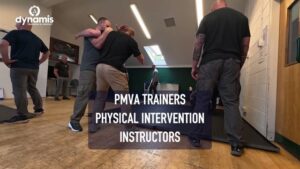

This post is about conflict management | personal safety | dynamis training. The technique being demonstrated in the picture accompanying this post is promoted as a way for controlling violent patients in a hospital setting. Unfortunately, it is potentially a deadly restraint — and its use might go far beyond control and extend to culpable homicide or corporate manslaughter.
⚠️ Warning: This restraint technique is deadly. If your organisation teaches or uses anything resembling this, stop immediately and seek professional restraint training.
Mortui Vivos Docent — The Dead Teach the Living
Restraint training has moved on a lot in many areas since its early days. Unfortunately, we have had to learn many lessons along the way — a path paved with the tragic remains of those who succumbed to fragile techniques and deadly restraint procedures. Even now, controversy exists about what constitutes safe restraint — and even whether such things exist.
Mortui Vivos Docent — “the dead teach the living.” Let’s learn from tragic circumstances and try to improve what we can.
The team in the photo are assembled and have each taken a specific role in the restraint intervention — which is to be commended. However, there are serious issues.
Problem One: Full Body Weight on the Torso
Prone restraint has been the subject of many controversies and continues to divide opinion. However, even those who promote its use — and who use it perhaps hundreds of times per year in their services — will admit that it is best to keep the full weight of your body off the subject’s torso.
Sitting on, lying on, pressing down with your hands, putting your knee on, or in any other way applying your mass through the subject’s body into a solid surface (like the floor or a wall) is acknowledged as dangerous. In the photo we can see that two staff are effectively lying backwards on top of the subject. If he tries to get up, they can — and probably will — lean onto him to keep him secured on the floor under them, leading to a deadly restraint.
Problem Two: You Can’t Monitor What You Can’t See
In this deadly restraint position, the staff are unable to monitor the subject’s vital signs. Watching out for warning signs is critically important — especially in a hospital setting where it can be assumed that the subject is already a medical emergency for one reason or another.
Epilepsy, Sickle Cell Disease, Chronic Heart or Lung conditions, obesity, and a number of other clinical conditions can drastically increase the risk that your subject might suddenly die during a restraint incident. These, combined with the position and the weight issues, could conceivably put your subject in a very physiologically compromised situation.
You need to be aware of the vital signs during the incident — but how can you do that if you are leaning on his back, staring at the ceiling, and unable to see their face? Granted, there may be another person in the room or off-camera in our example who is advocating for the health of the subject, but nevertheless it is a critical component of a safe holding procedure and therefore one worthy of note.
📊 Clinical risk factors: Epilepsy, sickle cell disease, chronic heart or lung conditions, and obesity all multiply restraint risk. In a hospital setting, assume every patient has at least one — monitor vitals constantly or don’t restrain at all.
Conflict Management | Personal Safety | Dynamis Training: Designing Safety Into Every Restraint
Two non-negotiable principles emerge from this example: keep weight off the torso and never lose sight of the subject’s face and vital signs. If your restraint position makes either impossible, it’s the wrong position.
More in this series of brief training tips on restraint techniques — and deadly restraint techniques — to avoid as we continue in our next post.
Until then, go safely,
Gerard O’Dea, Director of Training, www.dynamis.training
Visit our page for PMVA training: https://www.dynamis.training/pmva-training/
This guide on conflict management | personal safety | dynamis training is part of our ongoing work with schools and academies.